
The state-owned carrier Indian has finally made its way into the e-ticketing club.

Outward remittances under the Reserve Bank of India's (RBI's) liberalised remittance scheme (LRS) surged by 50.64 per cent to $9.1 billion in the April-June quarter (first quarter, or Q1) of 2023-24 (FY24), driven by healthy growth across segments due to a revision in the timeline of tax collected at source under the LRS scheme and normalisation in international travel. Major drivers include equity and debt investments, deposits, and the international travel segment, among others. According to the latest RBI data, the amount remitted under LRS stood at $9.1 billion in Q1FY24, compared with $6.05 billion in the same quarter last year.
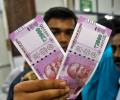
Image used for representational purpose only. Photograph: Jayanta Dey/Reuters The Congress also said demonetisation has come a full circle and added that the Rs 2,000 note was a "band-aid to cover up the foolish decision of demonetising" Rs 500 and Rs 1,000 notes.

Despite its admirable competence and proven track record, the RBI doesn't have the capacity to supervise an economy that's growing so fast and becoming larger by the year, points out T C A Srinivasa Raghavan.

Defence Minister Rajnath Singh on Sunday claimed that Prime Minister Narendra Modi has been receiving invitations for functions scheduled much after the Lok Sabha polls, which showed the 'entire world believes his return to power is inevitable'.

'Dharti par jo Rab hota hai, woh hai pitaah (There's a God on earth, and it's a Father).'

Of the total, the financial creditors - banks, bond holders and other financial institutions - have claimed Rs 86,892 crore.

Cricket climate change to medical practice, dropped candidates have their non-political life sorted.

Indian companies are expecting generous tax incentives from the Union Budget that will help them invest more in building capacities in the coming years. While the productivity-linked incentives (PLIs) are a good start to spur local manufacturing, the government should also take steps to boost consumer demand, which is not showing encouraging signs, say chief executive officers (CEOs) of India Inc. Statistics released by the Reserve Bank of India (RBI) shows that Indian banks had sanctioned loans worth Rs 75,558 crore in 220 new projects - a record low - in the pandemic-hit financial year ending March 2021. This is not showing any signs of a significant pick up in the last nine months of the ongoing financial year.

A 'White Paper' versus 'Black Paper' battle erupted on Thursday as the Centre and the Congress unveiled documents and crossed swords over the handling of the Indian economy during the nearly 10 years of the BJP-led NDA rule and the previous 10-year tenure of the Congress-led UPA government.

India appears poised to sustain its growth in a more durable way than before with the economy carrying the momentum from FY23 into the current fiscal year, the Annual Economic Review for 2022-23 released by the finance ministry on Thursday said. However, the report cautioned that escalation of geopolitical stress, enhanced volatility in global financial systems, sharp price correction in global stock markets, a high magnitude of El-Nino impact, and modest trade activity and FDI inflows, are factors that could constrain the pace of growth. "Should these developments deepen and dampen growth in the subsequent quarters, the external sector may challenge India's growth outlook for FY24," the finance ministry said.

Indian fintechs and associated entities are hoping that the Union Budget 2024 will provide a boost and empower firms to extend their reach beyond Tier-II regions, with an emphasis on supporting enterprises led by women. The fintech industry, which has witnessed regulatory reforms over the last year, expects the Budget, scheduled to be presented by Finance Minister Nirmala Sitharaman on February 1, will further encourage financial inclusion, empower micro-small-medium enterprises (MSMEs) with lending solutions, and push for upskilling initiatives for the country's young workforce.

'The lack of a majority isn't the issue. He has enough in 240, especially as none of his allies can pull down his coalition.' 'That's why he's started as if this were just another, normal term. That pretence is vital for him.' 'The change for Modi 3.0 comes not from numbers, but from the new environment of contestation,' points out Shekhar Gupta.

According to data compiled by BS Research Bureau for BSE 100 companies, seven public sector companies -- Indian Oil Corporation (IOCL), Bank of India, Union Bank, Bharat Petroleum (BPCL), Oil and Natural Gas Corporation (ONGC), Hindustan Petroleum (HPCL) and GAIL -- have reduced their employee costs ranging from one per cent to 21 per cent.

Finance Minister Nirmala Sitharaman on Thursday said the Indian economy is witnessing a strong recovery after a long and strict lockdown. Addressing a press conference to announce more stimulus measures to boost growth, she said macro-economic indicators are pointing towards recovery. She noted that COVID-19 active cases have declined from over 10 lakh to 4.89 lakh with case fatality rate (CFR) at 1.47 per cent.

Nearly a third of an average Indian citizen's consumption budget is spent on food.

The Indian rupee is expected to trade between 80 and 84 against dollar in the first three months of 2023 with support from overseas inflows though worsening current account deficit (CAD) and reduced interest rate differential between the US and India pose challenges. According to a Business Standard Poll of 10 participants, most said the rupee could gain strength in January due to foreign inflows, and the Reserve Bank of India (RBI) is not expected to allow the currency to depreciate ahead of the Union Budget scheduled on February 1. The rupee depreciated 10.15 per cent in 2022, its worst performance since 2013 as the war in Europe and the interest rate increase by the US Federal Reserve prompted investors to flee emerging markets.

Next set of Q4 FY16 earnings, progress of monsoon along with election poll outcome will dictate market trend this week

Equity benchmarks Sensex and Nifty ended on a mixed note on Wednesday as the euphoria about the Budget fizzled out, with investors going for profit-taking ahead of the Fed interest rate decision. The 30-share BSE benchmark Sensex climbed 158.18 points or 0.27 per cent to settle at 59,708.08 after it trimmed most of the intra-day gains. During the day, it had zoomed 1,223.54 points or 2 per cent to 60,773.44.

The two major railway unions have proposed to the government an unprecedented alternative to privatisation or inviting foreign investment, to help raise funds and improve revenue.

Asia Securities Industry & Financial Markets Association (Asifma) has raised concerns about the Securities and Exchange Board of India (Sebi) proposal to introduce a T+0 settlement cycle. The industry association of top foreign portfolio investors (FPIs) has stated that this move could give rise to several issues, including the bifurcation of the market, liquidity fragmentation, and deterioration of market quality. In a discussion paper floated last month, Sebi has proposed a separate same-day settlement cycle that will run parallel to the existing T+1 cycle, where trades are settled the next day.

In a notification, the home ministry also said if the amount exceeds, the individuals will now have 90 days to inform the government instead of 30 days earlier.

It is high time the Indian government signalled discomfort with the UK providing refuge to those accused of financial crimes in India, states Jaimini Bhagwati.

Now that the economy is growing at a higher-than-expected rate, it is time to accelerate the pace of fiscal consolidation, and the Budget could be a good starting point, argues Rajesh Kumar.

The finance minister has emphasised on the quick disbursal of additional loans to MSMEs, to simplify process, formats and documentation.

GNPAs of public sector banks are now at a staggering 11.2 per cent of their advances.

On Monday, the biggest gainers in the Sensex pack were Sun Pharma, Bajaj Finance, Vedanta, Yes Bank, Tata Motors, HCL Tech, IndusInd Bank and Kotak Bank, HCL Tech, Infosys and Bajaj Auto.

The stakes are significant for the BJP in this round as the party had in 2019 won an overwhelming majority of these seats, including all in Gujarat, Chhattisgarh, Bihar and Madhya Pradesh, that will go to polls on May 7.

From the Sensex pack, Mahindra & Mahindra, UltraTech Cement, Power Grid, State Bank of India, ITC, Titan, Tata Motors and ICICI Bank were among the major winners. Tata Consultancy Services, Bajaj Finance, Tech Mahindra, Asian Paints and HDFC were among the major laggards.

The review plea by one of the petitioners Udit Sood has been filed with the apex court registry.

If the concerns over risking political capital are overcome, the long-term gains for the Indian economy will be immense, asserts A K Bhattacharya.

Ajit Mishra, vice president, research, Religare Broking, answers your stockmarket queries.

The Budget should use the extra RBI surplus to better effect, suggests A K Bhattacharya.

Congress general secretary (communications) Jairam Ramesh said they will pose three questions a day to Prime Minister Narendra Modi over the issue.

India's mutual fund (MF) industry had barely any retail footprint when it completed 50 years in 2013. MFs had Rs 7 trillion in assets under management (AUM) in March 2013, of which around Rs 5 trillion was in institution-focused debt funds. By comparison, bank deposits in the country stood at Rs 67.5 trillion around the same time.

'Who would think of making a bank of poor women? She had vision and boldness.'

The BJP and TRS took digs at each other over the celebrations marking the annexing of the erstwhile Nizam-ruled Hyderabad state to the Union of India, with the former slamming vote bank politics behind the lack of official commemoration so far while the ruling party warned against communal forces trying to divide the society.
The Indian financial system is driven more by the domestic factors and "Fed rate cut is one of the triggers to review rates ", said Union Bank Bank of India chairman M V Nair.

Earlier, the Reserve Bank of India was the approving authority.
